

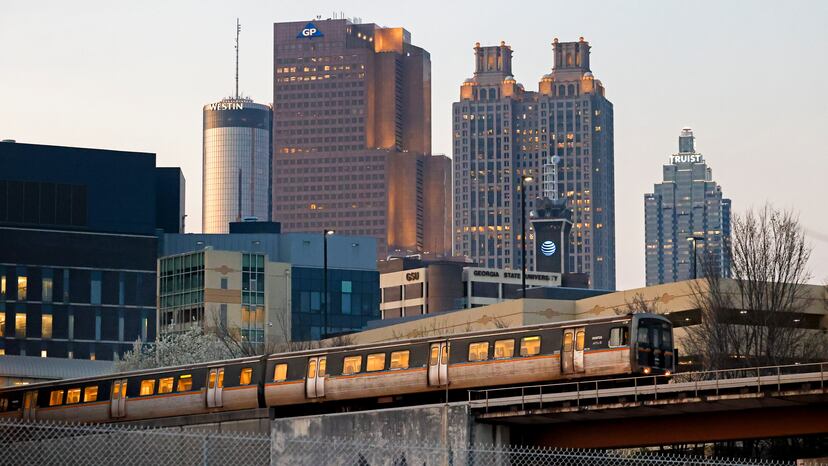
Photo Credit: Jason Getz on file at the Atlanta Journal-Constitution
Reader Discretion Notice: This article discusses recent incidents of violence, including a fatal attack and other assaults. It includes references to death, injury, and public safety concerns that readers may find distressing. Reader discretion is advised.
June is National Ride Transit Month, a time to celebrate the joy, freedom, connection, and possibility that public transportation brings to our community. The month arrives as Atlanta prepares to welcome an estimated 500,000 international visitors for the World Cup games who will rely on public transit as a primary way to move through our city.
However, for many, a shadow is cast on these festivities.
This weekend, a 66-year-old woman and beloved community member named Margaret Sams-Swan was killed in a horrific act of violence while riding MARTA (Metropolitan Atlanta Rapid Transit Authority). We mourn with her family, loved ones, fellow riders, transit employees, and everyone shaken by this brutal assault.
Before anything else, we want to acknowledge something plainly: this was terrifying. For many riders, especially women, incidents like this do not feel abstract or statistical. They feel personal. They can change how safe people feel moving through the city and simply existing in public space. That fear deserves to be taken seriously.
At the same time, we believe moments like this require care and honesty in how we talk about violence, safety, and transit. We think it’s important not to isolate this tragedy from the broader reality we are living in as a society.
Over the past month, there have been several other unprovoked attacks against women in Atlanta’s public spaces. Just weeks ago, on May 14, 23-year-old Alyssa Paige was fatally stabbed in broad daylight on the Atlanta Beltline near the Northeast Trail.
Days later, on May 19, another woman was stabbed with a butter knife at First Watch, a popular brunch restaurant in Decatur (just outside of Atlanta), also in broad daylight. While unimaginably traumatizing, the injuries she incurred were non-life-threatening.
Clearly, our society has an issue with violence. Last year, 96 homicides were recorded in Atlanta. The root causes of this violence are complex and interconnected: long-standing disinvestment in communities; lack of access to housing, healthcare, and mental health support; and broader patterns of trauma and inequality that shape many American cities.
Transit exists within this system.
In the aftermath of this weekend’s attack many in our community have expressed fear of riding MARTA. This fear is real, and it should be met with meaningful action to help people feel safe using public transportation every day. As we process this, we also think it’s important that our response is grounded in the full picture of risk.
It’s easy to forget that more of our neighbors’ lives are taken by traffic crashes than by homicide. In 2024, there were more than 425 traffic deaths compared to 410 homicides in five core counties of Metro Atlanta, according to Propel ATL’s report, “The Human Cost of Mobility.” While it rarely generates the same emotional response as isolated acts of interpersonal violence, traffic violence is one of the leading causes of death in our city.
That difference in perception matters. Interpersonal crime, especially on transit, can feel immediate, intentional, and inescapable. On a bus or train, you are in a shared, enclosed space you cannot easily leave, and that loss of control can increase perceived danger.
Traffic violence, by contrast, feels more controlled. When a crash occurs, it is typically framed as an accident, an unfortunate but isolated moment rather than a persistent public health threat. Further, when fatal crashes happen there is a sense of psychological distance compared to interpersonal crime.
When we look at the full picture of risk, however, the data are clear: out of all modes of transportation, public transit remains one of the safest. Research consistently shows that taking public transit is roughly 10 times safer than traveling by personal vehicle. Other analyses show that not only is the crash risk significantly lower but so is the crime risk. (Explore the data here.)
That may feel difficult to reconcile in this moment. But part of why this weekend’s tragedy was so shocking is because acts of violence like this on transit are actually quite rare.
We stand with the family of Margaret Sams-Swan and support calls for stronger safety measures on MARTA, including visible staff, well-maintained stations, and reliable reporting systems. We also stand with the families of Alyssa Paige and others impacted by violence across our community and believe these tragedies call for a sustained, systems-level commitment to addressing the root causes of violence in Atlanta.
At Propel ATL, our role in this work is helping build an Atlanta where people can move safely no matter how they get around, whether you are walking, biking, rolling, driving, or riding transit.
So this Ride Transit Month, we are holding two truths at once. We are grieving deeply with a community shaken by violence. And we are continuing to believe in transit as a lifeline, as a public good, and as one of the safest, most equitable, and most sustainable ways for people to move through our city.